Realito hideout
The Big SleepRealito hideout is the secluded frame house where Mona Mars is concealed, a place whose separation from the highway offers temporary cover but whose isolation also leaves its occupant exposed to Lash Canino’s control. The hideout links concealment to danger: it protects Mona from immediate police suspicion, yet becomes the setting where Philip Marlowe discovers the truth about Rusty Regan and prepares to confront Canino.
Setting and Access
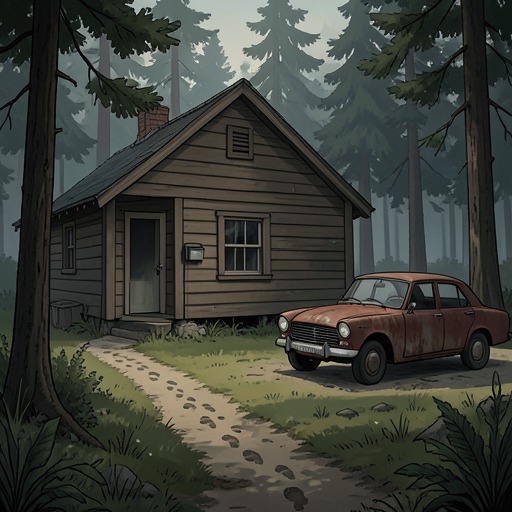
The house stands beyond a small garage and paintshop run by Art Huck, on a side road near Realito. The approach branches from a highway beside a bare stretch of foothills; the garage is about a hundred yards from the road and presents a blank wall to passing traffic. Beyond it, the frame house sits well back from the road behind a thin clump of trees. Its front windows are lit but shaded, and a brown coupe waits on the gravel drive. These features make the site difficult to inspect casually from the highway while leaving its occupants dependent on the narrow road and the nearby garage.
The route to the hideout is first reconstructed from Agnes Lozelle’s account. She says she and Joe Brody followed a brown coupe driven by Mona, with Canino beside her, until it turned off toward the frame house. They watched from the highway, then Joe approached the house after dark and saw lights and a radio inside, with the coupe still outside. The account gives Marlowe a specific location to investigate, but it also makes clear that the information comes from an earlier observation and could be out of date.
Concealment and Surveillance
Mona’s presence at the house is part of an arrangement intended to keep suspicion away from Eddie Mars. She tells Marlowe that if she had not hidden there, the police would have been certain Eddie had murdered Rusty Regan. Her concealment thus serves more than one purpose: it keeps Mona out of public view and helps sustain a misleading explanation of Regan’s disappearance. Marlowe counters her assumption directly, telling her that Eddie did murder Regan.
The concealment is not the same as freedom. Canino is at the house, and Mona explains that she came there to show Eddie she would cooperate by hiding and that he need not have her guarded. She says she loves Eddie, but the circumstances reveal how little control she has over the arrangement: Canino holds the key to the handcuffs restraining Marlowe, and Mona cannot release him from them. The remote house therefore functions both as a refuge from official scrutiny and as a space where Canino’s authority can operate with limited interruption.
Marlowe’s Arrival and the Confrontation
Marlowe reaches the site after Agnes’s directions lead him to Art Huck’s garage. He confirms the garage sign, notices the light beneath its shut doors, and continues to the house, where the shaded windows and coupe identify it as the place she described. He then returns to the garage and draws Canino’s attention there, beginning a confrontation shaped by the separation between the two buildings and the darkness around them.
Inside the house, Mona questions why Marlowe has come and insists that Eddie had done him no harm. When Marlowe tells her that Eddie was responsible for Regan’s death, the claim changes what the hideout means to her: the place that had served as a defense of Eddie’s story now confronts her with its falsity. She leaves the room, returns with a kitchen knife, and saws through the knots in Marlowe’s rope. She cannot remove his handcuffs because Canino has the key, but her decision to free him is a consequential break with the concealment that brought her to the house.
The confrontation turns on Marlowe’s use of the garage and the car outside. After starting the car, he positions himself by its rear wheels and draws Canino toward it; the resulting encounter ends with Canino dead. Mona comes out of the house cautiously, acting as a shield for Canino, and calls to him that she cannot see through the misted windows. Her appearance confirms how closely the house and garage are bound to the danger of the encounter: the route between them becomes part of Marlowe’s plan, while Mona is drawn out of concealment into the immediate aftermath.
Spatial and Narrative Significance
The hideout’s location is defined by thresholds and restricted visibility: a highway gives way to a side road, a blank garage wall screens the site, trees stand between the house and road, and shades cover the lit windows. These details make the house legible to Marlowe only through patient observation and information supplied by others. Its apparent remoteness does not remove it from the urban network of cars, pursuers, and police suspicion; instead, it creates a pocket where those forces can be manipulated out of public view.
The hideout also contrasts with the Sternwood estate, where wealth is displayed across terraces, gardens, a garage, and views toward the oil field that produced the family fortune. In the account of that estate, the oil wells remain visible even after the family has moved uphill and the surrounding field has partly become a public park. At Realito, the landscape is narrower and more exposed: a roadside garage, a set-back house, and the foothills beyond. Across these settings, private space does not mean safety. The estate’s boundaries separate wealth from its origins; the hideout’s distance from the highway conceals Mona while enabling Canino’s control and Marlowe’s intervention.